
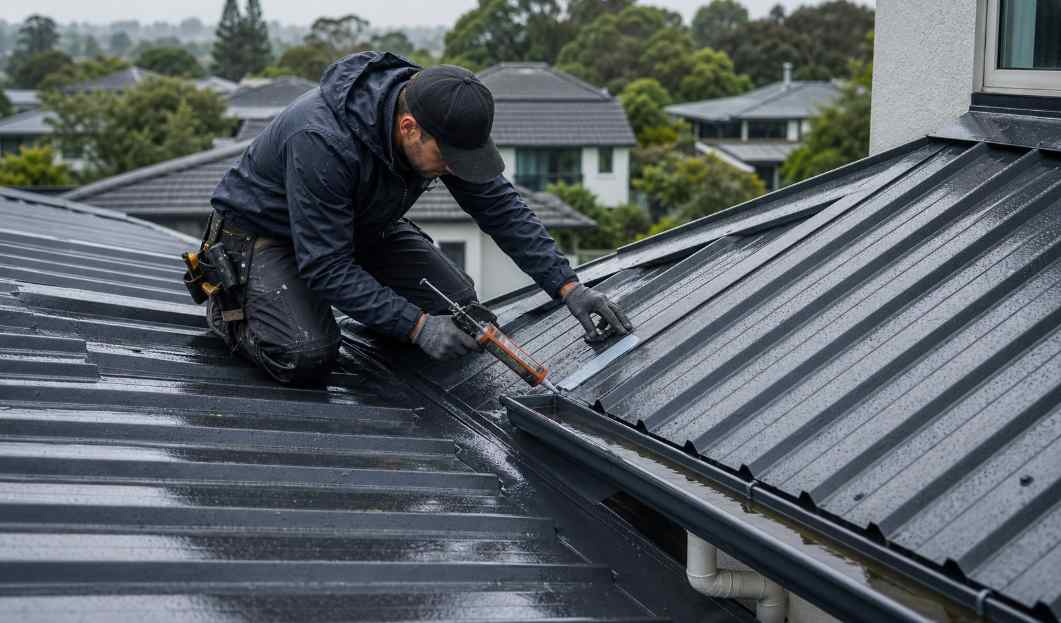
You’ve Spotted a Leak. Here’s What to Do Before the Roofer Arrives
It is raining, there is a drip on the ceiling and the first instinct is to climb up and find it. Please don’t. Wet roofs are slippery and the visible stain is rarely directly under the hole. The better plan is to limit damage, gather information and call someone who repairs roofs for a living.
If you need roof repair in Auckland, what you do in the first hour makes the roofer’s job faster and your repair bill smaller.
Step one: contain the water
Put a bucket under the drip and a towel around it. Move furniture and electronics out of the way. Stay clear of light fittings near wet areas, and if water is pooling in the ceiling, call a professional rather than tackling it yourself.
Step two: document everything
Take photos and note the date and weather. Mark the edge of any stain with a pencil so you can see if it spreads. Where is the leak relative to walls, chimneys, skylights or roof junctions? Those details help a roofer narrow down the source.
Note whether it leaks in every rain or only in wind-driven rain. That alone can point to flashings, fixings or a gap at a junction.
Step three: look from the ground
Check the gutters, downpipes and the roof edge from below. Look for sagging gutters, lifted sheets, missing fixings or debris. Binoculars help. Stay off the roof.
What a proper repair covers
Auckland Roofing, which has served the region for over 120 years, lists a range of repair and maintenance services: leak detection and repairs, inspections and reports, flashings and gutter repairs, re-screwing and re-fastening, roof cleaning and coating, and preventative maintenance plans.
That list tells you something. Leaks are often not a hole in the roof at all. They come from a flashing that has moved, a screw that has backed out or a gutter that no longer drains. Finding the cause is the real work, and the reason an inspection and report is worth having.
Warning signs before the leak
The best repair is the one you do before the ceiling stains. Auckland Roofing lists warning signs on its repair page. Common things worth checking from the ground include damaged flashings, loose or lifted fixings, rust or discolouration and blocked gutters.
A yearly inspection, or a preventative maintenance plan, costs less in the long run than reacting to water damage. Waiting until winter is the most common mistake.
If you are not sure whether a mark on the ceiling is new, photograph it now and compare after the next heavy rain. A record with dates is useful to a roofer.
Repair or replace?
A good roofer will tell you honestly. A localised failure usually calls for repair. A roof with widespread problems may justify re-roofing. Ask for the inspection report so you can see the reasons, not just the recommendation.
Auckland Roofing is a member of the Roofing Association and offers a free, no-obligation quote, so you can get an informed view before deciding.
Frequently asked questions
What causes most roof leaks?
Frequent causes include faulty flashings, loose fixings and blocked gutters, though a proper inspection is needed to confirm.
Should I go up on the roof to check?
No. Inspect from the ground and leave the roof to a professional.
Can a leak be fixed without replacing the whole roof?
Often yes, depending on the cause and the condition of the rest of the roof.
Who do I call?
Auckland Roofing can be reached on (09) 525 3095.
A leak is rarely an emergency of the roof. It is a message. The sooner it is read properly, the cheaper it is to answer.